Who's in control? An AI governance framework for regulated operations (2026)
Who's in control? What AI governance means for regulated operations, a six-step framework, and what to look for in AI governance tools.
AI is brilliant at lots of things. It can clear an overflowing inbox, automatically extract data you need out of a long document and draft a reply in seconds. Unfortunately, it's just as good at being confidently wrong. Ask it for a legal precedent and it might invent one, complete with a case name that sounds entirely real. In a regulated business, a confident mistake like that can end up in front of a client, a regulator or, as the Crown Prosecution Service found out, a High Court judge.
In July, the Crown Prosecution Service admitted that two non-existent cases had been cited in extradition appeals, and that generative AI may have been the source. It put the cause down to human error in failing to check them. Then in November, The Guardian reported on a CPS prosecutor citing an imaginary case to the High Court after an AI search. The problem? Nobody was governing the AI.
Every business leader is currently navigating an AI tightrope. How do you get the value and efficiency AI offers, without fudging regulation and letting clients down? That's the job of AI governance.
Below, you'll find what AI governance means for regulated operations, a six-step framework to build your own, and what to look for in AI governance tools.
What AI governance means for regulated operations
AI governance is the set of rules, roles and records that decide what your AI is allowed to do, and who's accountable for mistakes. It covers every AI system you run, from the agents your vendors supply to the ones your own teams built.
In regulated operations, solid AI governance means you can answer three questions at any moment.
Which agents are working on what?
Who checked their output?
And where's the evidence?
Trust is what lasts
New agentic-first firms are popping up every week, all keen to take a bite out of the established players' apples. The ones that stick offer services they can trust.
Although innovation has been controversially ahead of regulation for a while, auditors are now catching up. ISO/IEC 42001, published in December 2023, is the first international standard for an AI management system. It sets out how organisations should manage AI risk, controls and data across a system's life. Any AI agent that touches your controls falls within the scope of the audits you already face, like SOC 2.
Putting guardrails around AI and keeping audit evidence in one place is best industry practice, but it's easier said than done.
Your AI needs a harness
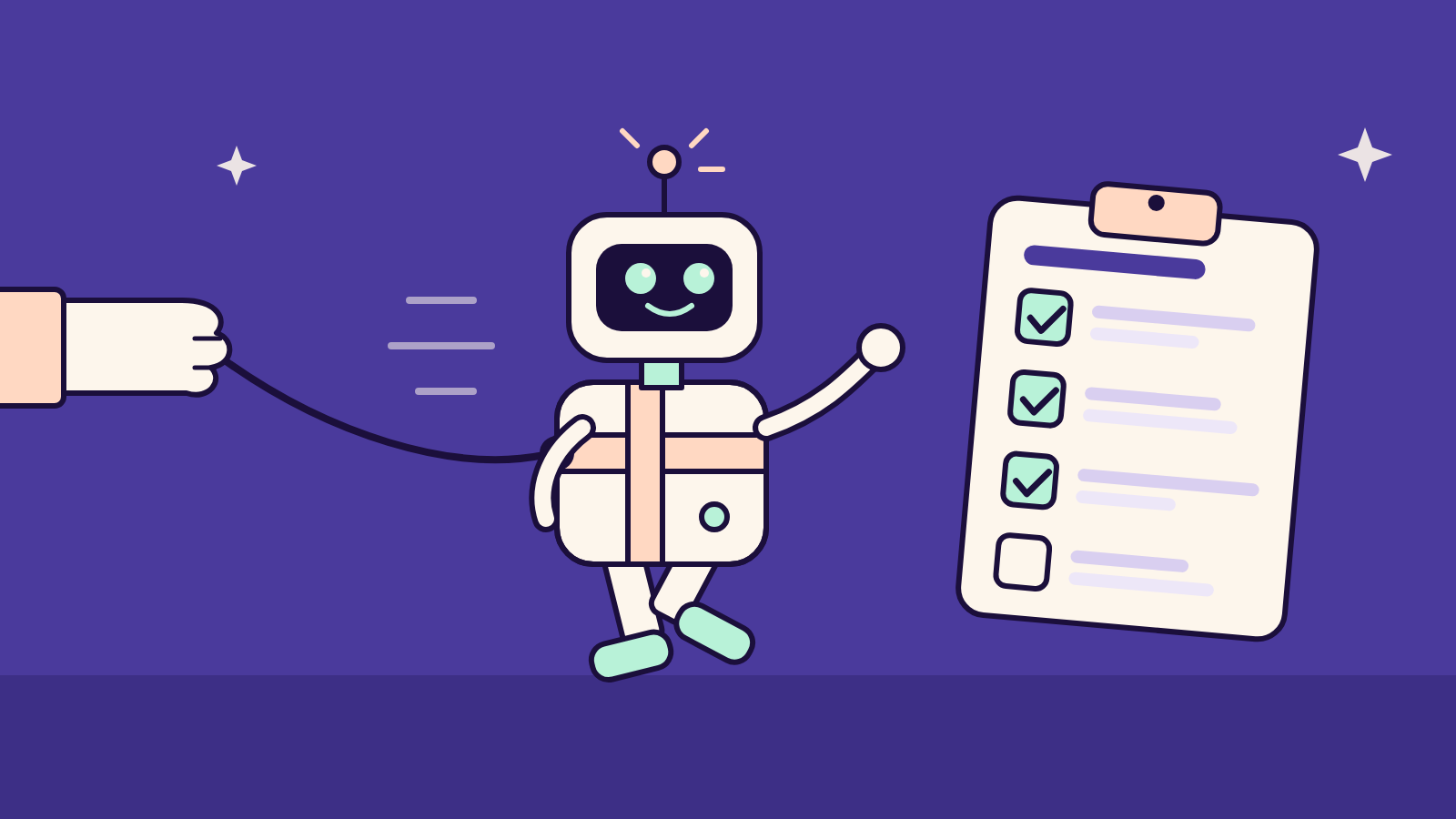
Think of AI governance like the harness you'd put on a toddler at the park. They still get to run around and explore, but you can step in before they make a dash for the duck pond. Your AI works the same way. It can move fast and get plenty done, but it can't wander off somewhere it shouldn't. The harness wraps around your people and your agents, whether those agents follow fixed rules or come up with their own answers. It sets what each one can do, checks the work and records every step.
Getting AI governance wrong can cost you clients and reputation fast. So build your AI governance framework in from day one, before you need it. Here's how.
A solid AI governance framework in six steps
1. Set your risk levels
For each process, decide what AI can do on its own, where a person needs to approve its work, and the work that AI shouldn't touch.
2. Build an agent inventory
List every agent you use, both third-party and team-built. Give each a named owner. That owner is the first port of call when an agent makes a mistake, and they're responsible for fixing and reporting on it.
3. Keep humans firmly in the loop
When decisions need human judgement, humans should always make the call. Set clear thresholds for when a person has to check what AI has produced. This was the step that went missing at the CPS, where nobody had checked the cases before they reached the court.
4. Check work independently with clear rules
The owner of an agent shouldn't check their own agent's work, and an agent definitely shouldn't check its own. Use clear, deterministic rules to validate AI output before it's used.
5. Build the audit trail as you go
Log every action, decision and human check in one place. Being audit ready then happens as a by-product of everyday work, instead of a last-minute scramble. This is where efficiency savings really shine.
6. Keep governing after go-live
Keep an eye on your AI long after go-live. Models change and so does your work. Keep testing your agents to make sure they stay accurate. Maintaining oversight is crucial.
What should you look for in AI governance tools?
A framework sitting in a slide deck is just theoretical. The real test of AI governance is when the solution is built into how the work runs. Whichever you choose, check the AI governance tool can...
- Keep inventories of every agent, third-party and in-house, with a named owner for each
- Send work to a person when risk or uncertainty crosses a threshold you set
- Run deterministic rules that check AI output before it's used
- Log every action, decision and override in one audit trail
- Govern people and agents in the same workflow, so nothing falls between them
- Keep testing agents after go-live, and flag when accuracy drifts
A rudimentary spreadsheet can list agents, but it won't tick many of these boxes. We'll help you work out which tools fit your operation.
Don't wait for the auditor, sort AI governance out today
The best time to build AI governance is before the auditors are at the door. We'll help you build your AI harness from day one, so when the audit lands, you've got a record of AI you can stand behind.
Book a free call with our experts to learn more.
Resources that helped us write this article
- 2026, Legal Futures: CPS admits putting hallucinated cases before High Court
- 2026, The Guardian: 'A serious failure': CPS prosecutor cites imaginary case to High Court after AI search
- 2023, ANSI National Accreditation Board: ISO/IEC 42001: Artificial Intelligence Management Systems (AIMS)